
This Omron HBF-375 review looks at the Karada Scan body composition monitor for buyers who want more information than body weight alone. The HBF-375 combines a standing platform with a handheld display and hand electrodes. It estimates body fat and skeletal muscle percentages, includes regional readings, and keeps reference results for four users.
Our verdict: Consider this Omron weighing scale if you want a standalone home monitor with hand-and-foot sensing and an on-device progress display. A basic scale is a simpler choice if you only want your weight; an app-connected model makes more sense if automatic phone logging is essential.
As an Amazon Associate, we earn from qualifying purchases.
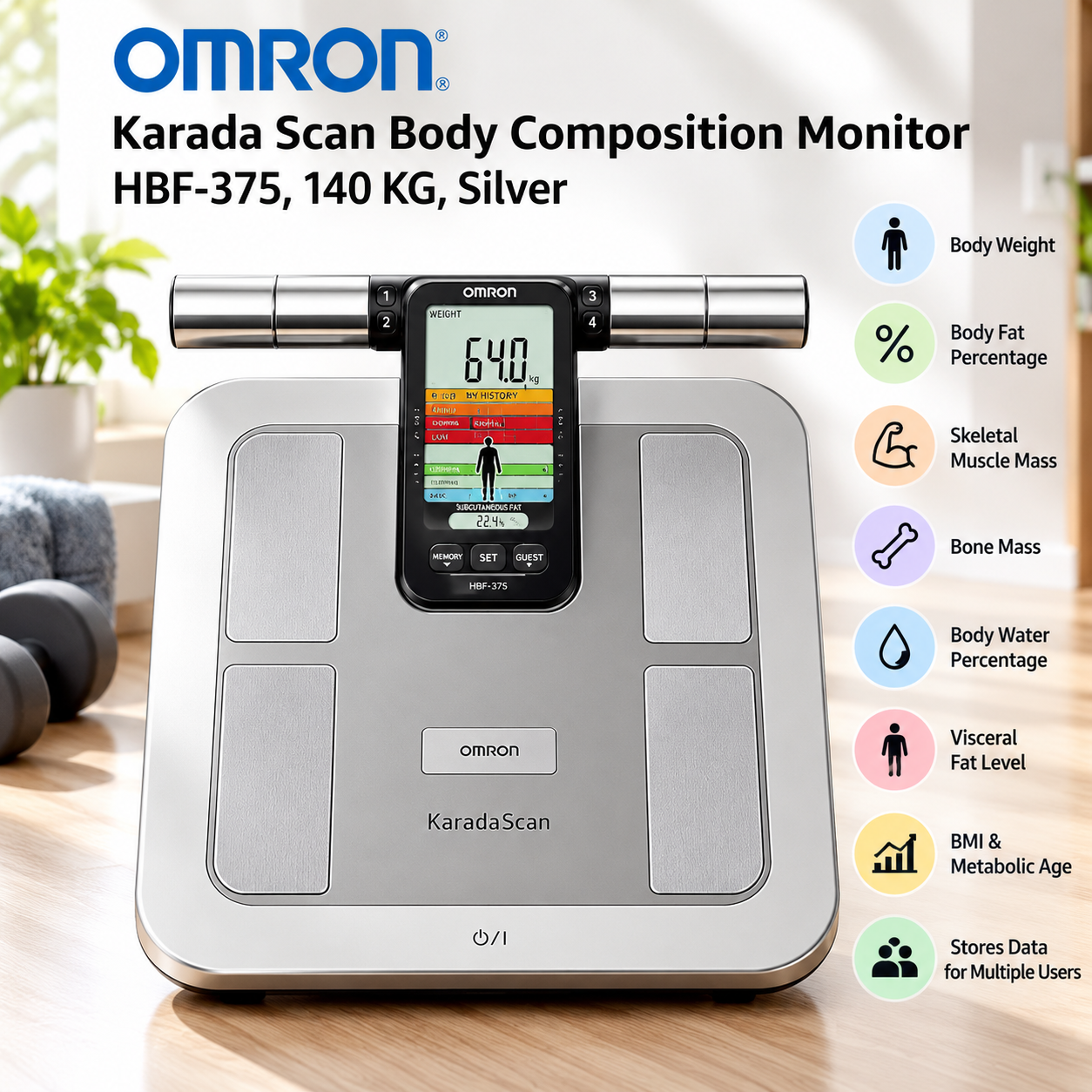
Omron HBF-375 review: verified specifications
| Feature | HBF-375 / HBF-375-AP specification |
|---|---|
| Type | Home body composition monitor with handheld display and foot platform |
| Sensing | Eight contact sensors across both hands and feet; bioelectrical impedance analysis |
| Maximum body weight | 135 kg in Omron’s specifications and instruction manual |
| Weight display increments | 100 g up to 100 kg; 200 g above 100 kg, up to 135 kg |
| Body-composition outputs | Body fat %, skeletal muscle %, subcutaneous fat %, visceral fat level, BMI, resting metabolism and body age |
| Regional readings | Whole body, trunk, legs and arms for supported segmental percentages |
| Profiles and history | Four personal profiles; Guest mode; reference readings and progress comparison up to 90 days |
| Connectivity | Standalone display; Omron India lists no Bluetooth connectivity |
| Power | Four AA batteries, R6 or compatible LR6 alkaline |
| Size and weight | Approximately 329 × 304 × 54 mm; 2.6 kg including batteries |
Before ordering: The supplied Amazon listing says 140 kg, two AAA batteries and 4 g readout accuracy. These differ from Omron’s HBF-375 documentation. Confirm the exact model and rating with the seller; do not plan to use the documented 135 kg model above its limit.
1. Hand-and-foot sensing is the main reason to choose it
The HBF-375 uses contacts at the hands and feet instead of relying only on a foot platform. You stand barefoot on the electrodes and hold the display unit in front of you. This design supports its whole-body and segmental estimates.
The method is bioelectrical impedance analysis, often shortened to BIA. The monitor uses electrical resistance together with profile information to estimate composition. It does not directly see fat or muscle. The practical benefit is a repeatable home record when you follow the same measurement routine.
In this Omron HBF-375 review, the hand-and-foot design is a stronger buying reason than the number of results on the screen. It also means a little more involvement than stepping on a simple bathroom scale.
2. Understand what each result actually means
| Result | How to use it |
|---|---|
| Body weight and BMI | Track weight alongside the height entered in your profile. BMI does not separate muscle from fat. |
| Body fat percentage | Follow the estimated proportion of body fat over time, rather than treating one reading as a precise assessment. |
| Skeletal muscle percentage | A percentage estimate, not muscle mass in kilograms or a measurement of strength. |
| Subcutaneous fat percentage | Estimated fat under the skin, with supported regional comparisons. |
| Visceral fat level | A device-generated level; it is different from a measured weight or scan of abdominal fat. |
| Resting metabolism and body age | Calculated reference indicators. Resting metabolism is not your total daily calorie requirement, and body age is not a diagnosis of ageing. |
The useful question is whether your longer-term pattern fits your goals, habits and other measurements. A small day-to-day shift in a composition percentage is not proof that you gained or lost that amount of tissue overnight.
3. Segmental readings add detail beyond a single percentage
The monitor provides supported subcutaneous-fat and skeletal-muscle percentages for the whole body, trunk, legs and arms. These regional estimates are the feature that separates it from a straightforward weight-only machine.
They suit buyers who want a more detailed record while following a consistent exercise or weight-management routine. They should not be interpreted as a diagnosis of an injury or a reason to change treatment. If you will rarely look beyond body weight, the additional display options may offer little everyday benefit.
4. Four profiles and the progress chart support household use
Four stored profiles let household members maintain their own information and reference results. Select the correct profile before measuring; someone else’s height or personal details can make the calculated results unsuitable for you. Guest mode provides a separate option for an occasional user.
The history function uses reference points such as the previous day and 7, 30, 60 and 90 days earlier. This is useful for reviewing changes without a phone, but it should not be confused with a downloadable daily spreadsheet covering every measurement.
For this Omron HBF-375 review, the on-device approach is both a strength and a limitation: it keeps the routine independent of an app, while buyers who want automatic exports or phone synchronisation should compare a connected scale.
5. A consistent measuring routine matters
- Place the monitor on a firm, level and dry surface. Avoid carpet and slippery flooring.
- Set the date, time and personal information as instructed in the manual.
- Remove the handheld display before stepping onto the platform.
- Measure barefoot with dry feet positioned on the foot electrodes, and hold the grip contacts correctly.
- Follow the illustrated posture, with the arms extended and approximately at a right angle to the body. Remain still until measurement finishes.
- Record results under similar daily conditions and compare trends rather than isolated numbers.
The handle and connecting cord need enough clear space for comfortable use. If standing steadily and holding the display is difficult, consider whether a simpler scale or an assisted measurement arrangement would be more practical.
Important suitability check: Omron warns against using this monitor with implanted electronic devices such as pacemakers or with electronic life-support equipment. Follow the manual’s safety guidance and consult the relevant clinician if this applies to you. The HBF-375 is intended for home use, not professional hospital assessment.
6. Capacity, display steps and battery details affect ownership
The documented maximum is 135 kg. This is a buying decision, especially for a user near that limit: verify the unit’s own label instead of relying on a marketplace title that says 140 kg.
The display changes in 100 g steps up to 100 kg and 200 g steps above that. Display resolution and measurement accuracy are different specifications; a small number on a screen does not automatically establish equally small measurement error.
Four AA batteries power the HBF-375. The handheld unit is connected to the platform by a cord, so store the handle in its holder and protect the cable. Its approximate 2.6 kg weight also makes it a more substantial appliance than the 394 g figure shown in the supplied marketplace details.
7. Omron HBF-375 review: who should buy it?
A good fit: A household seeking four profiles, regional composition estimates and a progress chart without depending on an app. It is most useful when users are prepared to follow the measurement instructions and look at longer-term patterns.
Compare alternatives: Choose a basic digital scale if you only need body weight. Look at connected models if phone logging is your priority, and choose a separately verified higher-capacity model if the intended user exceeds this unit’s rating.
The Omron HBF-375 review verdict is that its appeal comes from the combination of hand-and-foot electrodes, segmental estimates and household memory. Buy it for those features, not for unsupported claims of bone-mass testing or automatic app syncing.
Use the Amazon button to check the current price, selected seller, model code, return conditions and warranty. The supplied listing advertises a one-year manufacturer warranty; confirm coverage and retain your invoice.
Frequently asked questions
Is the Omron HBF-375 rated for 140 kg?
Omron’s product page and HBF-375-AP manual specify 135 kg. The supplied listing uses 140 kg wording, so confirm the exact unit with the seller before ordering.
Does it measure bone mass or body-water percentage?
Those are not listed HBF-375 outputs. Its documented features include fat and muscle percentages, visceral fat level, BMI, resting metabolism and body age.
Does the HBF-375 connect to a phone?
Omron India lists no Bluetooth connectivity for this model. Its display and memory are intended for standalone use.
How many people can save their information?
Four personal profiles are supported, with a Guest option for an occasional user.
Which batteries does it use?
The manufacturer specifies four AA batteries, rather than the two AAA batteries shown in the supplied marketplace details.
Is every composition feature available to every age?
No. The manual places age limits on individual outputs. Its full set is specified for ages 18–80; younger users and adults above that range should follow the manual’s restrictions.
More weighing-scale articles
For a simpler weight-only option, read our Hoffen HO-18 review. You can also browse weighing-scale reviews to compare the features you need.
Product references: Omron Healthcare India’s HBF-375 specifications and its HBF-375 instruction manual.
Reader discussion