
This Garmin Forerunner 265 review covers the 46 mm Music model in Black/Powder Gray. It combines a 1.3-inch AMOLED display, built-in multi-band GPS, onboard music and advanced training tools. Its main attraction is the connection between recording a run, planning the next session and understanding recovery.
Our verdict: the Forerunner 265 is a strong choice for runners who want structured workouts and recovery guidance on the watch. It makes more sense when you will use Training Readiness, race preparation and GPS regularly. If your priorities stop at steps, notifications and occasional exercise, much of its training depth may go unused.
As an Amazon Associate, we earn from qualifying purchases.
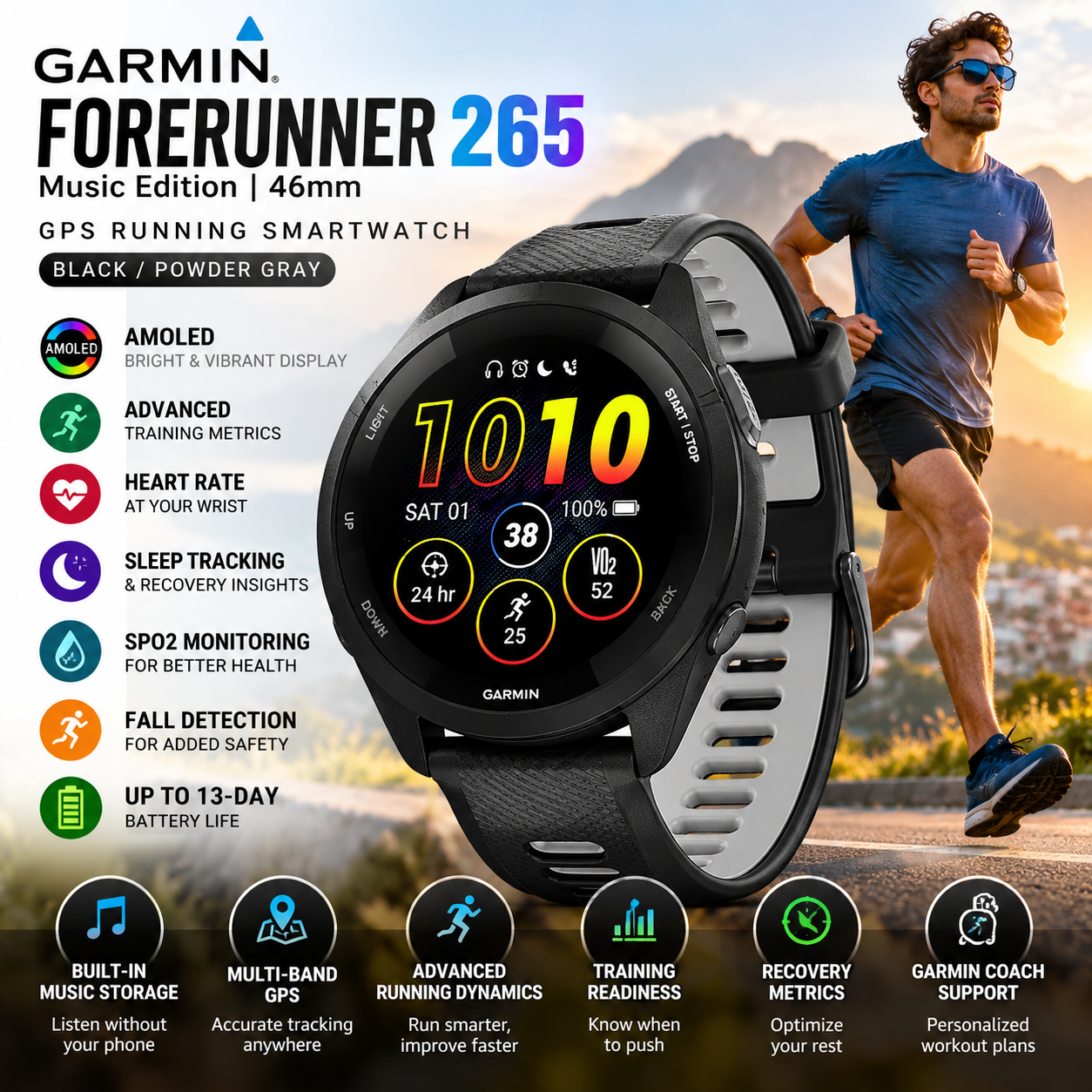
Garmin Forerunner 265 review: specifications at a glance
| Feature | Forerunner 265, 46 mm |
|---|---|
| Selected colour | Black/Powder Gray |
| Case dimensions | 46.1 × 46.1 × 12.9 mm |
| Weight | 47 g |
| Display | 1.3-inch AMOLED, 416 × 416 pixels; optional always-on mode |
| Controls | Touchscreen and physical buttons |
| Positioning | Built-in multi-band GNSS with SatIQ automatic selection |
| Training tools | Training Readiness, Training Status, daily suggested workouts, Garmin Coach and recovery time |
| Wellness tools | Heart rate, HRV Status, sleep tracking, stress tracking and Pulse Ox |
| Music and storage | Onboard music support; 8 GB total device memory |
| Connectivity | Bluetooth, ANT+ and Wi-Fi |
| Water rating | 5 ATM |
| Box contents | Watch, charging/data cable and documentation |
1. AMOLED and buttons serve different parts of a run
The 1.3-inch AMOLED screen presents workout information in colour, while physical buttons give you another way to operate the watch. Touch controls are convenient for browsing information; buttons are useful when starting a session or recording a lap without carefully aiming at the screen.
The 46 mm label describes the case class, not the screen diameter. Garmin specifies a 416 × 416-pixel display for this model. At 47 g, it is designed around sports use, but wrist fit remains personal. Compare the case against a watch you already wear, especially if you plan to keep it on overnight for sleep and recovery data.
2. Built-in multi-band GPS supports phone-free recording
The Forerunner 265 records outdoor GPS activities without borrowing your phone’s GPS. Multi-band GNSS provides an additional positioning option, and SatIQ can select the satellite mode automatically to balance positioning demands with battery use.
That distinction matters if you want to run without carrying a phone. For example, you can record a familiar route and review distance and pace afterwards. Satellite settings still influence battery life, so select them with the length of the session in mind. A clear satellite connection before starting is a better habit than beginning immediately and expecting the watch to reconstruct the opening section.
3. Training Readiness helps connect effort and recovery
Training Readiness uses inputs such as sleep, recovery and recent training load to provide a daily readiness score. Training Status adds a broader view of your recent training, while HRV Status brings overnight heart-rate variability into the picture. Morning Report places key information together at the start of the day.
The practical benefit is context. An easy session after a demanding week can be a deliberate training choice rather than a missed opportunity. Use the scores to review your plan alongside how you feel, your schedule and any soreness. Consistent wear gives the system more useful context than putting the watch on only for a single weekly run.
4. Race preparation gives the training tools a purpose
The Race Widget, daily suggested workouts and Garmin Coach help turn activity records into a plan. Suggested sessions can adapt to recent performance and recovery, while an upcoming race in Garmin Connect gives the training a clearer goal. Wrist-based running dynamics and running power add information for runners who want to study their sessions in more detail.
These tools are most valuable when you have a repeatable routine. Someone preparing for a 10K can use the watch to organise easy days and harder sessions, then review progress across several weeks. A casual walker may find the same data excessive. Choose the watch for the decisions it will help you make, rather than the number of metrics on its feature list.
5. Music can stay on the watch
This Forerunner 265 supports onboard music, so the “Music” wording in the listing describes a real feature. You can prepare supported music content in advance and listen through compatible Bluetooth headphones without keeping your phone beside you. Supported streaming providers may require a paid subscription for offline downloads.
Set up playlists and check headphone pairing before heading out. Downloaded playback is different from cellular streaming, and music uses additional battery power. If you normally run with a phone anyway, consider whether onboard music is something you will use often enough to influence the purchase.
6. Battery life depends heavily on the activity mode
The headline up to 13 days refers to smartwatch mode. It does not describe continuous GPS recording with music. Garmin publishes separate figures for the 46 mm Forerunner 265:
| Mode | Advertised maximum |
|---|---|
| Smartwatch | Up to 13 days |
| GPS only | Up to 20 hours |
| SatIQ / Auto Select | Up to 16 hours |
| All systems with multi-band | Up to 14 hours |
| GPS only with music | Up to 7 hours |
| Multi-band with music | Up to 6 hours |
Actual endurance varies with display settings, sensors, GPS mode and other use. For a long event, plan around the activity mode you will use and leave a reserve. A short daily run and an all-day outing place very different demands on the same battery.
7. Wellness, swimming and safety have distinct roles
Heart rate, sleep, stress and Pulse Ox provide wellness information alongside training records. These readings are estimates rather than a diagnosis. The 5 ATM water rating and swimming profiles also make the watch relevant to swimmers and multisport users; follow Garmin’s water-use and care instructions.
Incident Detection requires a connected compatible phone, network coverage and configured emergency contacts. It operates during supported outdoor activities. Assistance and LiveTrack also depend on connectivity. These tools can help share information with your contacts, but Garmin Connect does not call emergency services on your behalf. Phone-free GPS and music do not make the safety messaging phone-free.
Who should buy the Forerunner 265?
| Your priority | How this watch fits |
|---|---|
| Structured running | A strong fit if you will use workouts, training load and recovery guidance |
| GPS and music without a phone | Supported for activity recording and prepared offline music |
| Swimming and multisport training | Relevant profiles extend its usefulness beyond running |
| Simple steps and alerts | Consider whether a simpler tracker would meet the same need |
| Standalone emergency communication | Safety messaging requires a connected phone |
Garmin Forerunner 265 review: final buying verdict
Choose the Forerunner 265 for its combination of running guidance, built-in GPS, recovery context and an AMOLED display. The strongest reason to buy is a training routine that will use those capabilities regularly. Its value is less compelling when it will mainly display notifications.
Confirm the 46 mm model, selected colour, seller, regional warranty and return terms before ordering. Compare the current offer with your actual priorities. Our Garmin Venu Sq 2 review covers another Garmin format, while our Garmin Instinct 3 AMOLED review is useful if you are considering a larger outdoor watch.
Frequently asked questions
Does the Forerunner 265 have built-in GPS?
Yes. It supports built-in multi-band GNSS and SatIQ automatic satellite-mode selection.
Can I listen to music without carrying my phone?
Yes, using supported content downloaded to the watch and compatible Bluetooth headphones. Some music services require a paid subscription.
Does the 13-day battery figure apply to GPS workouts?
No. It is the smartwatch-mode claim. Garmin specifies up to 20 hours in GPS-only mode and up to 7 hours with GPS-only recording and music.
Is the Forerunner 265 the same size as the 265S?
No. This review covers the approximately 46 mm Forerunner 265. The 265S is the smaller version, with different dimensions and battery figures.
Does Incident Detection work without a connected phone?
No. This model needs a compatible paired phone and network connectivity to send safety messages to configured contacts.
Product references: Garmin Forerunner 265 specifications, battery life by mode and safety and tracking features.
Reader discussion