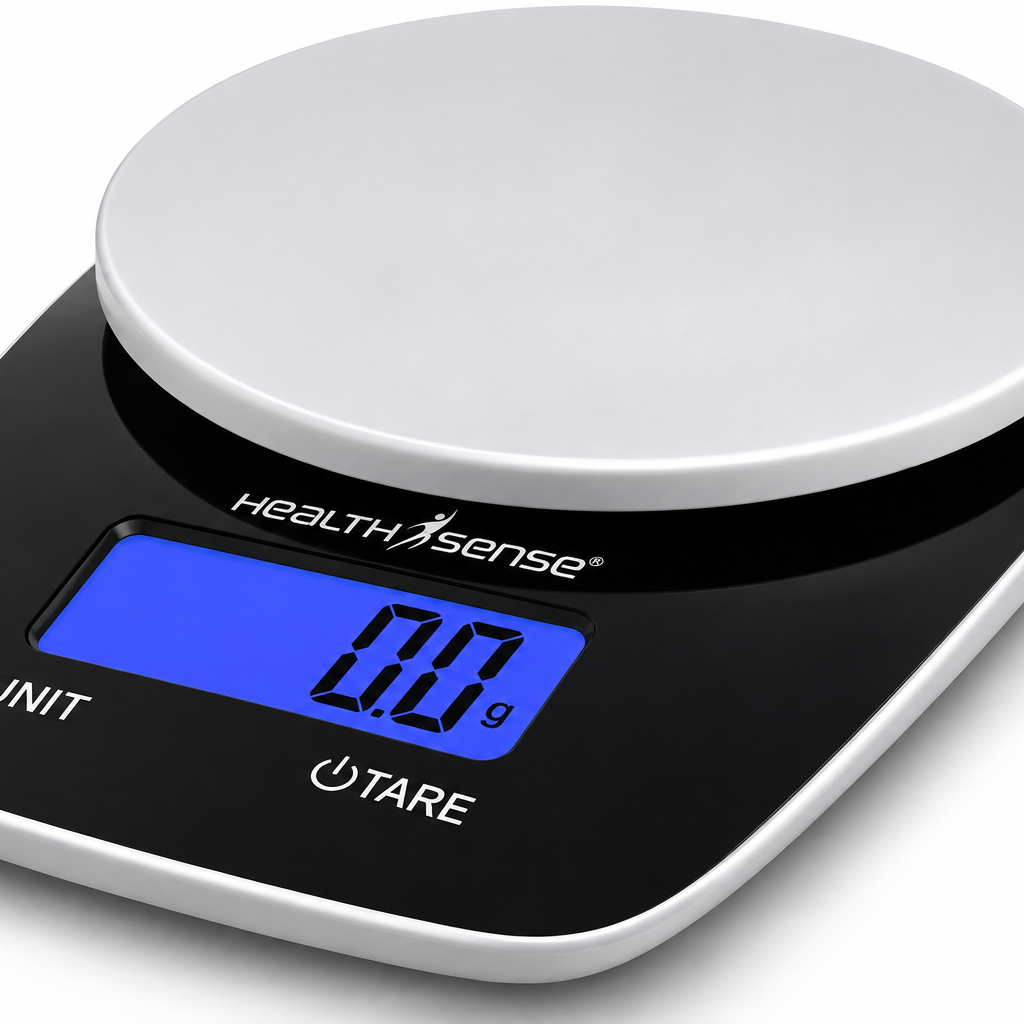
This HealthSense KS 33 review looks at a practical question: is the Chef-Mate a good fit for home baking and meal prep? The digital kitchen scale has a detachable bowl, a tare button and a listed 5 kg capacity. The main limit to watch is at the other end: the advertised range starts at 5 g.
Quick verdict: Shortlist it for everyday ingredient weighing and portioning. If you often measure tiny amounts of yeast or use heavy cookware, check the weight range before buying.
As an Amazon Associate, we earn from qualifying purchases.
HealthSense KS 33 review: specifications at a glance
| Feature | What to know |
|---|---|
| Model | HealthSense Chef-Mate KS 33 (KS33), black |
| Listed weighing range | 5–5,000 g |
| Unit modes | g, mL (water), lb:oz and fl oz |
| Display and controls | Blue backlit LCD, UNIT and TARE buttons |
| Scale and bowl size | Scale: 15.5 × 21.7 cm; bowl: 18 × 6.3 cm (listed) |
| Power and indicators | Two AAA batteries; auto shut-off, low battery and overload indicators |
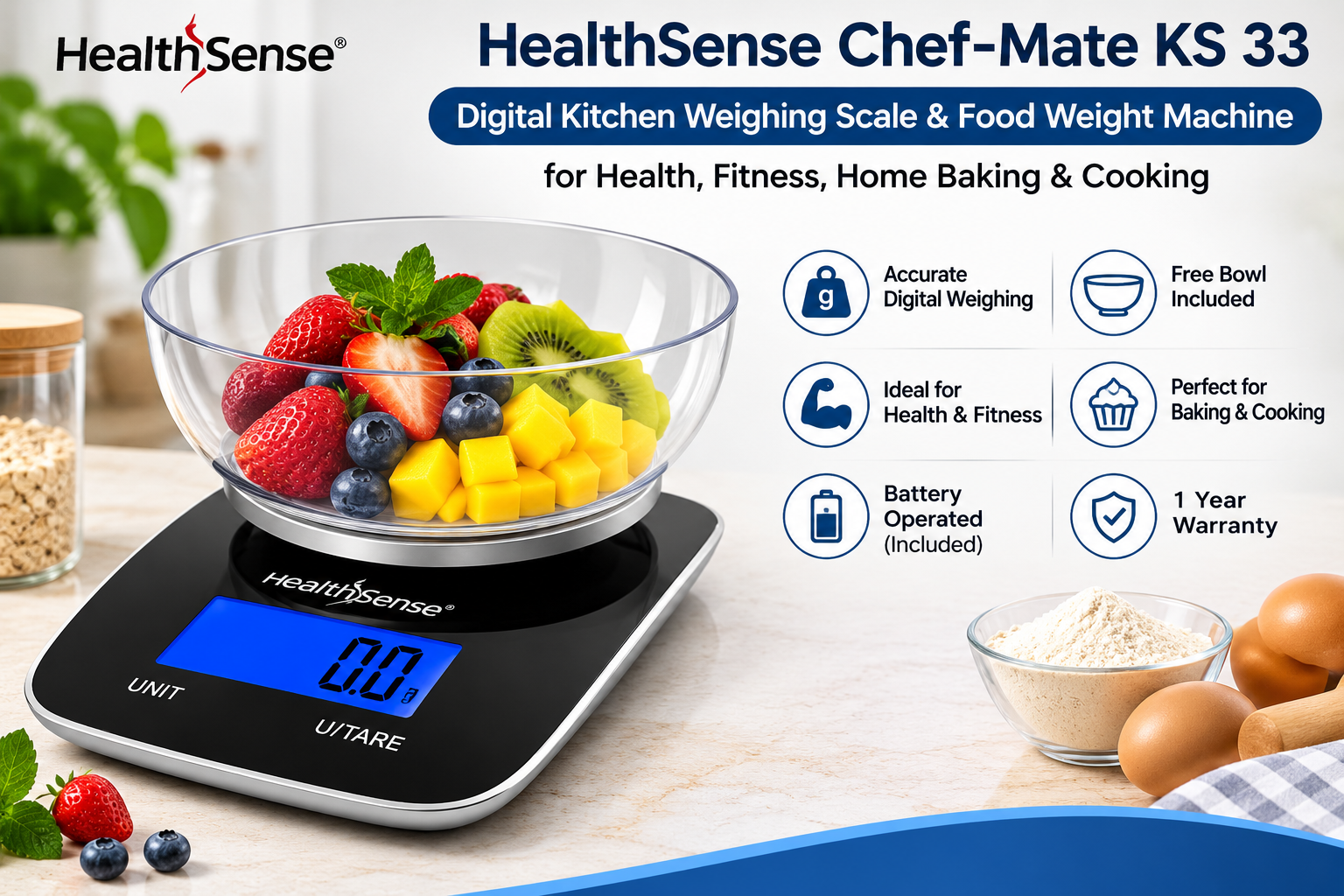
| In the box | Scale, detachable BPA-free plastic bowl, two AAA batteries, manual and warranty card |
| Listed warranty | One year from original purchase; check the seller’s terms |
1. Tare lets you weigh ingredients in the bowl
Set the empty bowl on the scale, select grams, and press TARE. Once the display reads zero, add your ingredient. For example, you can weigh 250 g of flour, tare again, then add 100 g of sugar. This works well when the ingredients can go into the same bowl. If you overshoot, it’s easier to remove the extra before you stir.
2. The 5 kg limit includes your container
Tare changes the reading on the screen; it does not change how much the scale can carry. A 700 g mixing bowl leaves up to 4.3 kg for ingredients within the listed 5 kg capacity. If you make large batches or weigh food in heavy cookware, add up the container and contents before choosing this size.
3. Check the 5 g lower limit for small ingredients
The product graphic lists a range starting at 5 g. That makes the KS 33 more suited to portions of oats, atta, rice and other everyday ingredients than to weighing 2 g of yeast or a pinch of spice. The lower limit, display increments and measurement accuracy are three different things. If very small quantities matter to you, look for a scale with documented performance in that range.
4. Use grams for recipes written by weight
The UNIT button switches between four modes. Grams are the easiest choice for most recipes that give ingredient weights. The mL mode is identified for water. Because oil and other liquids have different densities, use a measuring jug for their volume or follow the recipe’s weight in grams. Fluid ounces measure volume, while pounds and ounces in lb:oz measure weight.
5. The included bowl saves a separate purchase
The detachable bowl is handy for loose ingredients that would roll or scatter on a flat platform, such as nuts or dry dal. You can also use your own stable, flat-bottomed bowl as long as it fits and leaves the display visible. Lift the bowl off for cleaning and follow the manual for care of the scale base.
6. The controls are simple, with one trade-off
The backlit LCD and separate UNIT and TARE buttons keep routine weighing straightforward. Auto shut-off helps save the two AAA batteries, but it can interrupt a recipe if you leave the scale idle between steps. Keep your ingredients within reach, and check that the display is still on and set to the right unit before adding more.
7. It makes sense for everyday portions and baking
Consider the KS 33 if you want a countertop scale with a bowl included for weighing flour, dividing dough or portioning lunch. A wider platform may be more useful if you often weigh food on large plates. Likewise, if you routinely work with quantities under 5 g, choose a scale with a lower specified minimum. Check that your selected offer includes the bowl, batteries and one-year warranty.
Frequently asked questions
Can I use it without the included bowl?
Yes. Use a stable container that fits on the platform, then press TARE before adding food. Keep the combined weight within 5 kg.
Does it count calories or macros?
No. It measures the weight of food. If you log nutrition, use the measured grams with the food label or an app entry for the same food. For example, log cooked rice with a cooked-rice entry.
Can I weigh liquids on the KS 33?
Yes. You can weigh a liquid in grams in a tared container. The listed mL mode is for water; use a measuring jug if you need the volume of another liquid.
Specifications refer to the black KS33 variant shown in the Amazon India listing. Read how we review health gear.