
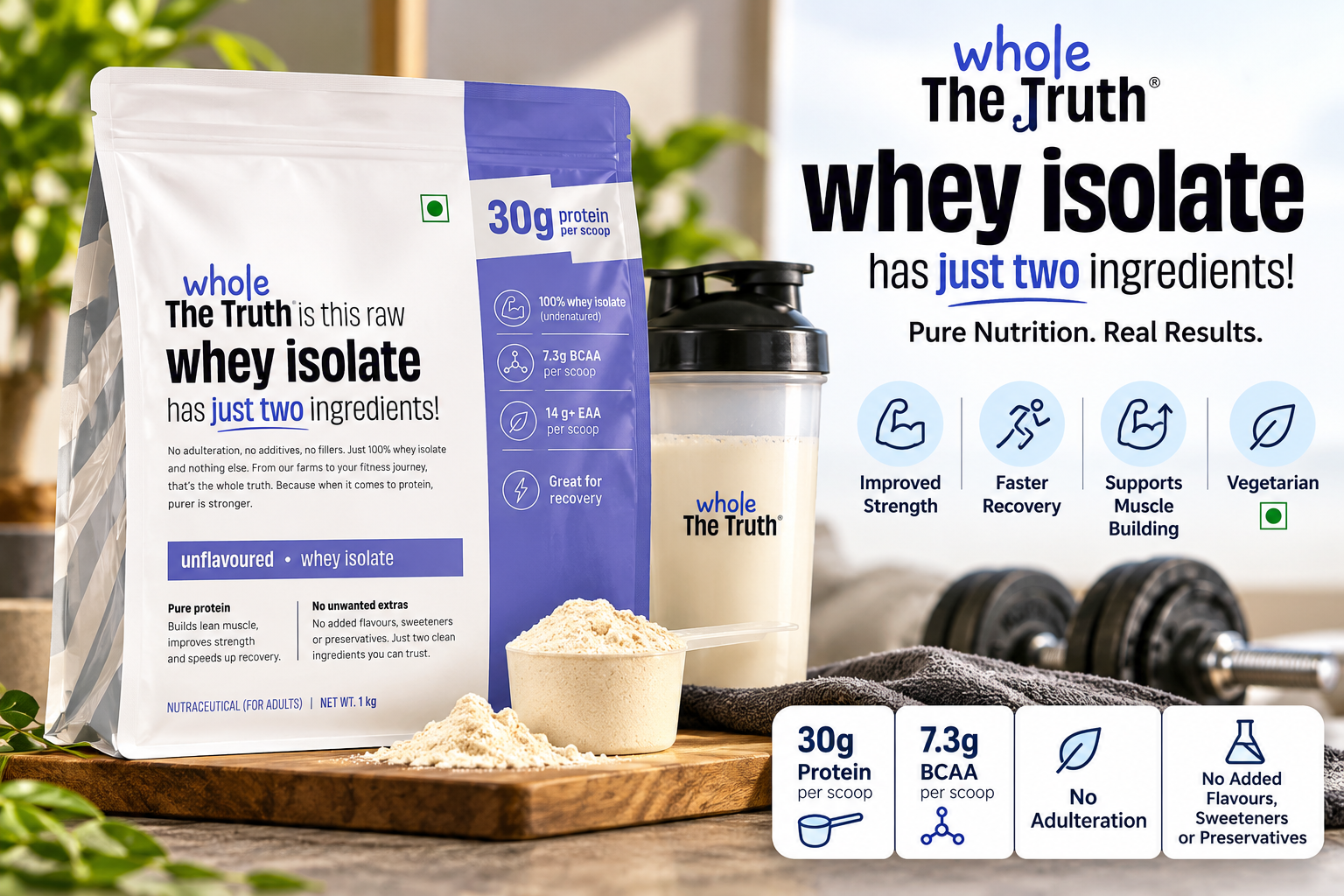
This Whole Truth whey isolate review examines the unflavoured 1 kg protein powder shown in the supplied Amazon photographs. It covers protein per scoop, ingredients, lactose, batch testing and price, so you can compare the right variant before buying.
Quick verdict: The Whole Truth Unflavoured Whey Protein Isolate is worth considering if you want an unsweetened dairy protein with a short ingredient list. Its main attractions are roughly 30 g protein per scoop and flexibility for shakes and food. The trade-offs are price, residual lactose and an unflavoured taste that may not suit everyone.
This guide compares the product’s published nutrition, ingredients, serving information and value. Product information checked on 3 October 2026.
Affiliate disclosure: As an Amazon Associate, we earn from qualifying purchases made through our links.
Whole Truth whey isolate review: 7 buying facts
- Buy the correct formula: this is the unflavoured isolate, not the 26 g concentrate or Light Cocoa blend.
- Scoop weight and protein weight differ: the brand recommends a 35 g scoop, while the pack headline states 30 g protein.
- It is dairy protein: the vegetarian label does not mean vegan or suitable for milk allergy.
- Low lactose is not lactose-free: the pack claims less than 0.5 g lactose per scoop.
- Unflavoured means unsweetened: expect a different experience from a sweet chocolate or vanilla shake.
- Testing claims need a batch check: match your pouch’s batch number with the brand’s published reports.
- Compare cost per serving: the 1 kg listing indicates approximately 28 servings; current checkout price matters.
Product specifications at a glance
| Detail | Unflavoured isolate reviewed here |
|---|---|
| Brand | The Whole Truth |
| Variant and pack | Unflavoured whey protein isolate, 1 kg pouch |
| Amazon product identifier | B0CLCB1XCH |
| Recommended scoop | 35 g, according to the manufacturer’s preparation guidance |
| Protein headline | 30 g per scoop |
| BCAA and EAA headlines | 7.3 g BCAA and 15.3 g EAA per scoop |
| Carbohydrate headline | 0.8 g per scoop in the supplied promotional image |
| Lactose claim | Less than 0.5 g per scoop |
| Approximate servings | 28, as shown in the supplied listing |
| Diet suitability | Vegetarian; contains milk-derived whey; not vegan |
These are product-specific label and manufacturer claims, not independent laboratory findings. The delivered pack’s nutrition panel and serving directions take priority if the formula changes. We have not copied the marketplace’s inconsistent “blend” and “4 kg” catalogue fields into this 1 kg isolate review.
How much protein does a scoop actually provide?
A scoop is a measure of powder, not pure protein. A 35 g serving can therefore contain about 30 g protein alongside small amounts of other components. Do not read “whey isolate as protein source” as a claim that every gram of finished powder is protein.
The package’s BCAA and EAA figures describe amino acids within that protein. They are not extra grams to add on top of the 30 g protein headline. For example, adding 30 g protein, 7.3 g BCAA and 15.3 g EAA would double-count components of the same serving.
For buying comparisons, read protein grams beside the scoop size. A competitor advertising fewer grams per scoop may simply use a smaller serving. Compare the delivered pack’s protein per 100 g and the cost of equivalent protein amounts before deciding.
Ingredients: whey isolate and bromelain
The manufacturer lists 99.4% whey protein isolate and 0.6% bromelain. The supplied pack describes instantised whey isolate, which helps the powder disperse in a drink. The brand also explains that instantisation involves lecithin; check the current label for detailed ingredient and allergen information.
Bromelain is included as a digestive enzyme. Its presence does not prove that this finished product will eliminate bloating or improve digestion for every user. A short ingredient list is a purchasing preference, rather than proof that a product is uniquely safe or more effective.
The supplied photographs promote no artificial sweeteners or added flavours. That may appeal to someone who wants to control the taste of their own shake. It does not establish that other approved sweeteners or flavourings are inherently harmful.
Low lactose, milk allergy and vegetarian suitability
The pack’s less-than-0.5 g lactose claim is relevant if you are comparing dairy powders, but it is not a lactose-free guarantee. Digestive tolerance varies between people. Mixing the powder with ordinary milk also adds lactose from that milk.
Milk allergy is different from lactose intolerance. Because whey is a milk protein, this product is unsuitable for someone with milk allergy, even when its lactose content is low. It is also unsuitable for a vegan diet. The NIDDK explanation of lactose intolerance describes the distinction and variation in tolerance.
What do the batch-testing claims tell you?
The supplied artwork says the brand tests batches for six areas: protein content, heavy metals, aflatoxins, microbial contamination, melamine spiking and pesticide residues. The manufacturer says it uses NABL-accredited laboratories and publishes batch reports.
Before relying on that claim, find the report for the batch on your actual pouch. Check the product name, batch identifier, report date, tested parameters and laboratory details. A report for another flavour or an older batch cannot establish the composition of the pack you receive.
We have not verified an individual batch report for this review. Accordingly, we do not label this powder independently certified contamination-free or doping-safe. Access to reports is useful for scrutiny; it is not a guarantee of every possible health or performance outcome.
How to mix and use the unflavoured isolate
The manufacturer recommends shaking one level 35 g scoop with 200 ml cold water or milk for about 30 seconds. Follow your delivered pack if its directions differ. Water avoids adding milk’s calories and lactose; milk changes both the taste and the final drink’s nutrition.
You can also consider an unsweetened powder for a smoothie or oats. Added fruit, milk, nut butter or sweeteners contribute their own nutrients and calories. An unflavoured powder still has an inherent taste, and we cannot judge this product’s flavour, texture or mixability from photographs.
Choose a quantity based on the gap in your daily diet rather than automatically taking multiple scoops. Protein supplements can help meet protein needs, but they do not replace a varied diet. The NIH Office of Dietary Supplements explains protein’s role in muscle maintenance and training, and the limits of performance supplements.
Price and value in India
The supplied Amazon screenshot shows ₹6,499 for the 1 kg pack. This is a screenshot reference price, not a verified current offer or a promised checkout price. At approximately 28 servings, that reference works out to about ₹232 per serving.
For today’s comparison, divide the final pack price by the stated serving count. Include delivery charges and any ingredients you add. Compare the same pack weight and exact formula; coupons, subscriptions and seller availability can change.
Check Current Price and Availability on Amazon
Isolate versus concentrate and Light Cocoa
The brand’s unflavoured isolate, unflavoured concentrate and Light Cocoa powder are separate products. Their nutrition and ingredient lists should not be interchanged simply because all carry The Whole Truth name.
If flavour matters more than an unsweetened formula, read our Whole Truth Light Cocoa whey protein review. For a broader adult nutrition drink, our Ensure Vanilla powder review explains a different balance of protein, calories and other nutrients.
Pros and limitations
Reasons to consider it
- About 30 g protein per scoop in the supplied pack headline.
- An unflavoured format for buyers who want to choose their own additions.
- A short declared ingredient list and low-carbohydrate headline.
- Brand-published batch reports that buyers can inspect.
Reasons to compare alternatives
- The reference price represents a substantial monthly cost if used daily.
- Residual lactose and milk protein restrict suitability for some people.
- An unflavoured powder may not suit someone seeking a sweet ready-to-drink taste.
- We have no hands-on evidence about mixability, taste or personal digestive tolerance.
Whole Truth whey isolate review: our verdict
The strongest reason to shortlist this 1 kg isolate is the combination of an unsweetened format, a high protein-per-scoop headline and access to the brand’s testing reports. Its suitability still depends on your diet, tolerance and budget.
Check the current price against comparable servings, inspect the delivered label and match the batch report. Do not expect a powder alone to guarantee strength gains, faster recovery or weight loss. Training, total food intake and consistency remain part of that decision.
Frequently asked questions
Is The Whole Truth unflavoured isolate vegan?
No. It contains milk-derived whey protein. Vegetarian and vegan describe different dietary requirements.
Is it lactose-free?
No lactose-free claim is established here. The supplied pack says less than 0.5 g lactose per scoop, and individual tolerance varies.
Why does the pack say 30 g protein when a scoop weighs 35 g?
The scoop weight includes all powder components. Protein is part of that total, so the two figures measure different things.
Is this the same as the 26 g unflavoured concentrate?
No. This article covers the 30 g unflavoured isolate, ASIN B0CLCB1XCH. Confirm the selected variant before paying.
Can it guarantee muscle gain?
No. It can contribute protein to your diet, but your results depend on training, nutrition and other individual factors.
What should I check when the pouch arrives?
Check the seal, exact variant, net weight, ingredient and allergen panels, expiry date and batch identifier. Compare that identifier with the brand’s published reports.
Sources and editorial notes
Product evidence: the supplied Amazon listing and packaging photographs for B0CLCB1XCH. Cross-check: The Whole Truth unflavoured isolate product information. General nutrition and lactose information: the NIH ODS and NIDDK resources linked above. Formulations, packaging and prices can change.
This article is general product information, not personalised medical advice. Ask a qualified clinician about suitability if you have kidney disease, dietary restrictions, take medicines, or are pregnant or breastfeeding.
Reader discussion