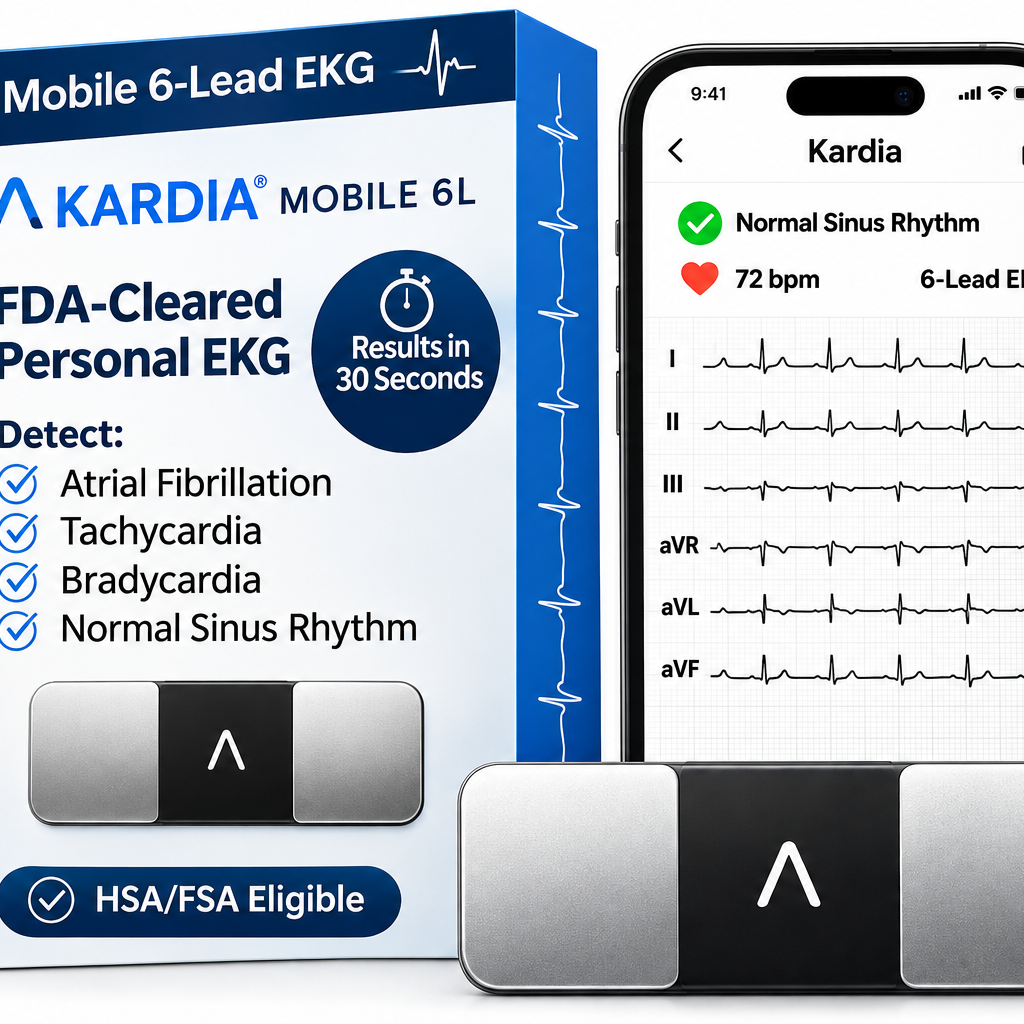
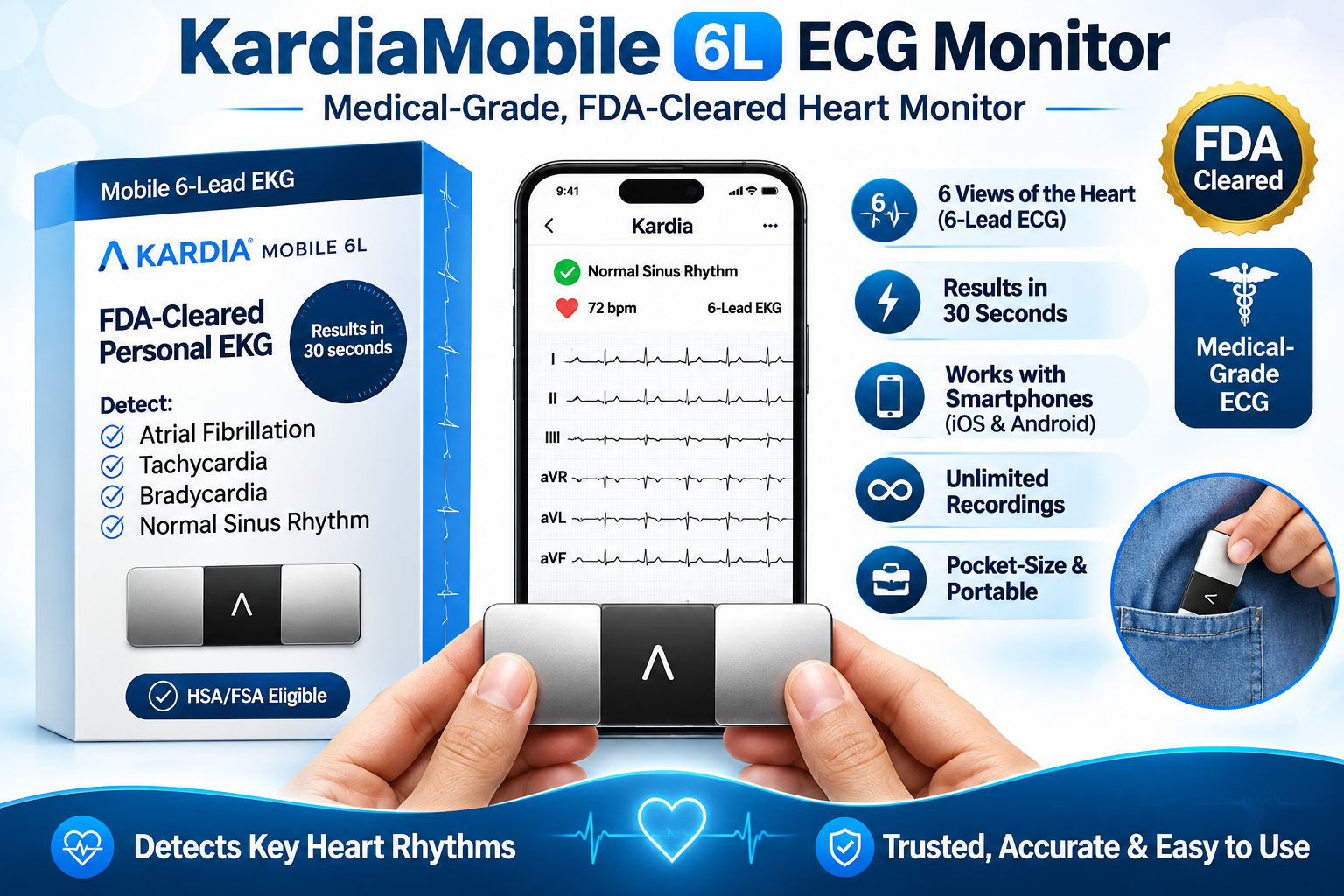
This KardiaMobile 6L review looks at what AliveCor’s pocket ECG monitor can tell you between appointments. It takes a 30-second rhythm recording through the Kardia app and can show six limb leads for your clinician to review.
Quick verdict: It makes the most sense when you and your clinician have a plan for when to record and how to share the tracing. It records on demand, so it cannot capture an episode you miss. It also cannot detect a heart attack or replace a clinical 12-lead ECG.
As an Amazon Associate, we earn from qualifying purchases.
KardiaMobile 6L review: specifications at a glance
| Feature | What to know |
|---|---|
| Device | AliveCor KardiaMobile 6L (model AC-019 in the Amazon India listing) |
| Recording modes | Single lead (I) or six limb leads (I, II, III, aVR, aVL and aVF) |
| Recording duration | A standard spot recording takes 30 seconds |
| Phone requirement | Kardia app on a compatible phone or tablet; check the exact model and OS |
| Power | Replaceable 3 V CR2016 coin cell, per AliveCor |
| Size and weight | About 9 × 3 × 0.7 cm; 24 g, per the Amazon India listing |
| Subscription | Basic recording does not require KardiaCare; check India-specific paid features separately |
| Warranty | One year in the supplied listing; confirm terms with the seller |
1. Six limb leads give your clinician more views
An ECG records the heart’s electrical activity. The 6L provides six limb-lead views: it records leads I and II and calculates the other four. That gives a clinician more views of the same short recording than a single-lead device. The 6L does not record the six chest leads found in a clinical 12-lead ECG.
2. Six-lead recording needs three points of contact
Open the Kardia app and choose six-lead recording. Rest a thumb or finger from each hand on the two top electrodes. Then touch the underside electrode to bare skin on your left knee or ankle. Sit still and keep contact until the recording is complete. For a single-lead recording, you use the top electrodes without the third point of contact.
If you are buying for someone else, check whether they can comfortably hold the device in that position and use the phone app. The extra electrode is useful only if the person can reach it and maintain contact.
3. The app labels a short recording
The basic app can flag possible atrial fibrillation (AFib), a slow or fast rate, or a pattern consistent with normal sinus rhythm. It can also return an unreadable or unclassified result. A flag is a reason to share the tracing with a clinician; it does not establish a diagnosis on its own. A normal result describes only the recording and may miss an episode that ended before you started.
4. Check phone compatibility and the battery type
Check AliveCor’s compatibility list for your exact phone or tablet and software version. The display and results are in the Kardia app, so a compatible mobile device is part of the purchase decision.
AliveCor specifies a replaceable CR2016 coin cell. Use that specification and the instructions supplied with the unit when replacing the battery, rather than relying on the generic battery fields in the marketplace listing.
5. Basic recording is separate from KardiaCare
AliveCor describes basic ECG recording, instant app results and sharing as available without a KardiaCare subscription. Paid features and review services can vary by country. If a specific detection or clinician review is important to you, check what is available through the app in India before buying a membership.
6. Save the tracing with context
Ask your clinician how they prefer to receive recordings. If you are using the device as part of a monitoring plan, keep the tracing with its date and time and a short note about what you felt. For example, “racing heartbeat while sitting, lasted two minutes” is more useful than forwarding the app label alone.
7. Buy it for spot checks, when they fit your care plan
Consider it if your clinician wants short rhythm tracings between visits and you can take a reading when needed. If you only want exercise heart-rate trends, a fitness tracker serves a different purpose. If episodes are too brief to record or happen during sleep, ask your clinician whether a prescribed monitor would be more suitable.
AliveCor says the 6L has not been tested or recommended for use with pacemakers or implantable cardioverter-defibrillators (ICDs). If you have one, ask your care team which monitoring option is appropriate.
Frequently asked questions
Can KardiaMobile 6L detect a heart attack?
No. It cannot detect or rule out a heart attack. If you have possible warning signs such as chest pressure or severe shortness of breath, seek emergency medical care immediately. Do not wait to take a reading.
Does it record all day?
No. It records when you start a session and maintain electrode contact. An episode outside the recording window will not appear in that tracing.
Can I send the recording to my doctor?
Yes. The Kardia app lets you share the ECG tracing. Ask your clinician where to send it and whether they want you to keep a symptom log.
Sources: AliveCor India product guide, AliveCor recording and battery instructions, Kardia device compatibility, FDA clearance and intended use, and American Heart Association guidance on heart attack warning signs. Read how we review health gear.